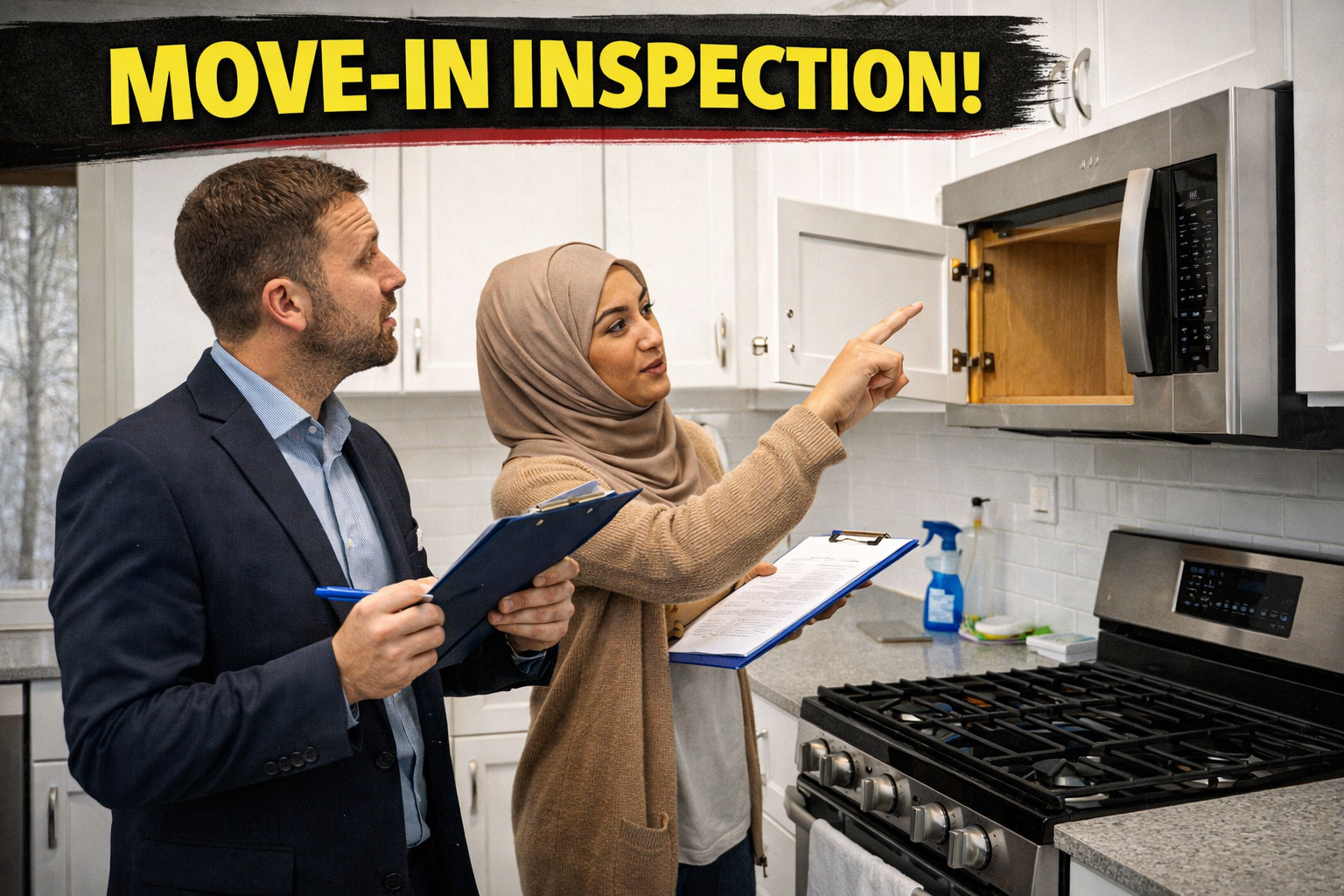
Here’s a story that happens more often than it should.
You move into a new place. The landlord hands you an inspection form, you walk through together, you both sign it. A few scuffs on the wall get noted. Maybe a sticky door. You move in, you get settled, life continues.
Then 30 days later you notice something — a water stain spreading under the bathroom vanity, a crack in the tile grout you never noticed, a window that doesn’t seal right. Not a big deal, you think. Probably wasn’t from you.
Fast forward to move-out. The landlord walks through, pulls out photos, and presents you with a bill. That water damage under the sink? That’s on you. The cracked tile? You. The window? Also you.
And here’s the brutal part: unless you can prove otherwise, you’re going to lose that argument.
The Inspection Form You Both Signed? It’s Not Enough.
Move-in inspection forms feel official. Two signatures, a date, a checklist — it looks like a contract. And it is, kind of. But a checkbox that says “bathroom — ok” is not the same as proof that the vanity had no water damage on day one.
Landlords know this. Not all of them are bad actors, but the ones who are know exactly how vague that form is. When you move out, the burden shifts to you to prove what was already there before you arrived. A checkbox doesn’t do that. A paragraph of notes doesn’t do that.
Photos and video do.
Alberta Makes This Worse Than You Think
If you’re renting in Alberta, you need to understand something: the Residential Tenancies Act leans hard toward landlords when it comes to damage disputes.
Security deposits can be held for up to one year after you move out if there’s a dispute. That’s money you might need for your next place, just sitting in limbo while you argue over a water stain.
The landlord can also apply your deposit to damages without your consent first — they just have to give you a statement. If you disagree, you have to take it to the Residential Tenancy Dispute Resolution Service (RTDRS). That means you have to file, you have to show up, and you have to prove your case .
In Alberta, “I didn’t do that” is not evidence. Timestamped photos from the day you moved in are.
What Actually Happens When You Miss Something
Let’s say you did your walk-through with the landlord and missed a slow leak under the sink. You didn’t cause it — it was probably there before you, maybe from a bad seal or an old pipe fitting. But you didn’t document it.
Over the next few months, that leak does what leaks do. The cabinet bottom warps. Maybe there’s a bit of mold starting. When you move out, that’s a significant repair. And without proof it existed before you, it looks like tenant damage.
Repair cost for water-damaged vanity cabinet: $400–$800. Mold remediation if it spread: potentially more. All of it coming out of your deposit — and if your deposit doesn’t cover it, you might get a collections notice for the rest.
This is not a hypothetical. This happens to renters in Calgary and Edmonton constantly.
What “Documenting” Actually Means
Not just a few photos of the living room.
Do this the day you get the keys, before you bring a single box in:
- Film a continuous walkthrough video, narrating as you go. Say the date out loud at the start. Open every cabinet, every closet, every drawer.
- Photograph every wall, floor, and ceiling — not just the ones with obvious damage.
- Get close-up shots of anything that looks worn: caulking, grout, corners of flooring, around windows, under sinks, around the toilet base.
- Check light fixtures, appliances, window locks, door hardware. Does everything work? Photograph what doesn’t.
- Take wide shots and detail shots of each room.
- Timestamp everything. Your phone does this automatically, but Google Photos or iCloud also logs metadata you can pull up later.
Then send it to yourself via email, or upload it somewhere with a clear date record. If it ever goes to RTDRS, you want evidence that can’t be disputed.
Why This Matters More Than People Realize
Most renters do a casual walk-through, sign the form, and assume good faith will carry them through. And often it does — because most landlords are reasonable. But you don’t document for the reasonable landlords. You document for the one who isn’t.
You won’t know which one you have until move-out day, when it’s too late.
A deposit in Alberta can be up to one month’s rent. On a $1,800/month apartment, that’s $1,800. On a $2,500 place, it’s $2,500. That’s real money. Money you earned. Money you’re legally entitled to get back if you left the place in the same condition you found it — minus what you can’t prove.
The Habits Worth Building
- Same day you get keys. No exceptions.
- Go room by room, methodically. Don’t rush it.
- Check the things people skip: behind the toilet, under appliances, inside the oven, the corners of the shower, the back of closets.
- Note anything the landlord told you verbally — “oh that scuff was there before” — in a follow-up email so there’s a written record.
- Keep everything. Move-out disputes can happen months after you leave. Cloud storage is free.
The Move-In Inspection Protects the Landlord. Your Documentation Protects You.
That inspection form is a legal document, yes. But it was designed to establish the baseline — and in practice, it often establishes a baseline that’s vague enough to be used against you.
Your photos, your video, your timestamps — that’s what fills in the gaps. That’s what you hand the adjudicator when a landlord says you caused something you didn’t.
Alberta law gives landlords a lot of room. Your documentation closes it.
Take 20 minutes on move-in day. Walk every room. Film everything. It’s the most valuable 20 minutes of your entire tenancy.
RentalProof Inspector is built specifically for this — a structured move-in walkthrough that guides you room by room, timestamps your photos
automatically, and generates a report you can keep as evidence. Free to use. Takes about 15 minutes.