A close friend of mine went through something no renter should ever have to deal with. We asked him to share his story — anonymously, for his family’s privacy — so other renters can learn from what happened before it happens to them.
Here’s what he told us, in his own words.
“The fire alarm woke us up.”
It was a weeknight in January. Dead of winter. Around 2 AM, I heard it — the fire alarm, screaming through the whole building.
I didn’t know what was happening. I just knew I had to get my family out.
I woke my wife up. Grabbed the kids. Got everyone dressed as fast as I could and brought them outside. No real coats, no plan, just get out of the building. That’s all I was thinking.
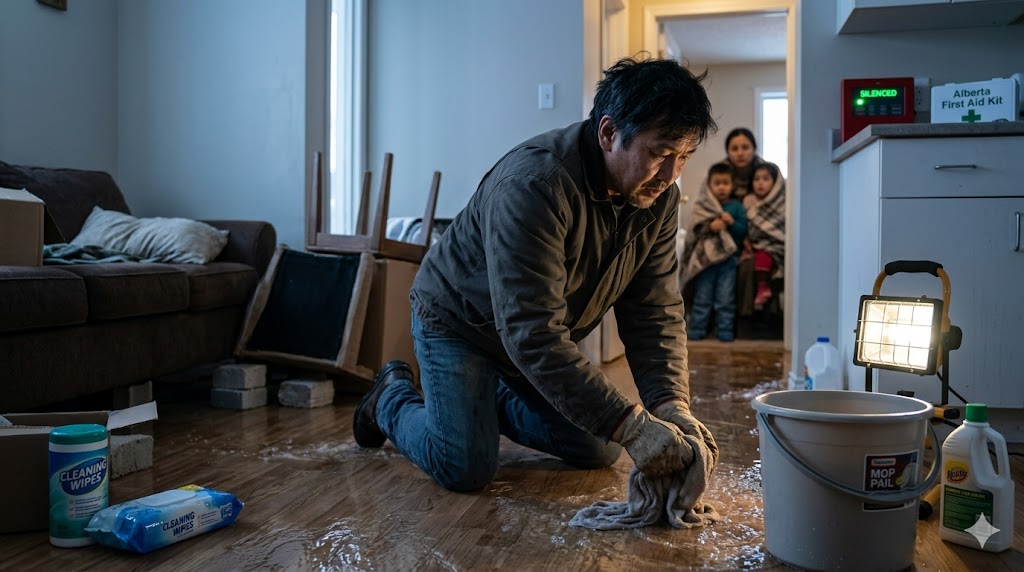
Firefighters showed up. Turns out it wasn’t a fire — a pipe had burst somewhere in the building and water was flooding through the units. Ours included. They worked on stopping the leak, but by that point, water was already all over our floors. Our stuff was sitting in it.
We stood outside for a couple of hours. My kids were cold. My wife was cold. It’s January in Alberta at 2 in the morning, and we have nowhere to go. No hotel lined up. No relatives close enough to drive to. Just standing there, waiting for someone to tell us we could go back in.
Eventually we did. I spent the rest of the night on my hands and knees, cleaning water off the floors, moving furniture, trying to save whatever I could. I finally laid down around 6 AM.
One hour of sleep
At 7 AM, someone knocked on my door. Then they opened it. Just walked right in. “Hello? Hello?”
I barely got up. I could hardly see straight. Turns out it was a contractor — the landlord had already sent someone over to start drying the unit. Industrial fans, dehumidifiers, loud machines running full blast through the apartment.
No phone call. No heads-up. No “hey, is now an okay time?” Just a stranger walking into my home while my family was trying to sleep after the worst night of our lives.
“Ask your home insurance.”
That same day, I emailed my landlord. I told him the unit wasn’t livable. Fans blasting 24/7, floors still wet, the smell already starting. I asked him to provide temporary accommodation — just somewhere my family could stay until the apartment was habitable again.
That evening, he replied.
“Contact your home insurance provider.”
That was it. That was the whole response.
No empathy. No acknowledgment of what we’d just been through. No offer to help, no follow-up, nothing. He just pushed the entire burden onto me and walked away from the conversation.
What the fuck…
The clause
I went back and read my residential tenancy agreement. There it was, buried in there:
The landlord is not responsible for any damages caused by incidents within the building.
That’s the clause he was hiding behind. That’s why he was so confident saying no. Because I signed it.
But that’s bullshit. A landlord can’t just write a line in a lease and make his legal responsibilities disappear. That’s not how tenancy law works — not in Alberta, not anywhere in Canada. Landlords have an obligation to maintain habitable conditions. You can’t contract that away just because a tenant signed a piece of paper.
I didn’t know that at the time. He did.
Credit cards and Airbnbs
My home insurance did eventually cover some of the costs — after a $1,000 deductible. But it didn’t cover everything.
We couldn’t stay in the unit. The fans were running around the clock. It was loud enough that nobody could sleep, the kids couldn’t function, and the place smelled like wet carpet. So we booked an Airbnb for one night. Then another. Then another.
Days turned into a week. Credit card bills piled up. I’m paying out of pocket for someone else’s building problem while my landlord sits there doing absolutely nothing.
He never followed up. Never checked in. Never asked if my family was okay. Complete silence.
What I regret the most
If you ask me what I’d do differently, I’ll tell you right now — I would have taken photos.
That night, in the middle of everything — the alarm, the water, the kids, the cold — I wasn’t thinking about documentation. I was thinking about survival. By the time the contractor showed up the next morning with his fans and equipment, the scene had already changed. The water was being sucked up. Things were being moved. The evidence was disappearing.
When I eventually looked into taking my landlord to court — to recover the accommodation costs, the damaged belongings, the repair bills — my case was weaker than it should have been.
No timestamped photos. No video of the water level. No documented record of what my unit looked like before the flood. No proof of what was damaged versus what was already worn.
I had the truth. But in a hearing, truth without evidence is just a story someone has to choose to believe.
What I wish I’d known
I wish I’d never signed that lease(residential tenancy agreement) the way it was. I wish I’d known that clause was a red flag. I wish someone had told me that just because something is written in an agreement doesn’t mean it’s legal or enforceable.
And I wish I’d walked through my apartment on move-in day with a camera and documented every wall, every floor, every fixture — so when the worst happened, I had something to fight back with.
I signed. I moved in. I assumed everything would be fine.
My landlord didn’t assume that. He planned for it. That clause was in the lease for exactly this situation. He was ready. I wasn’t.
This didn’t have to go this way.
Our friend’s story is painful to hear — but it’s far from rare. Across Canada, renters walk into leases with clauses designed to protect the landlord at the tenant’s expense. And when something goes wrong, they find out too late that they signed away leverage they didn’t even know they had.
Two things would have changed the outcome for him.
Before signing: catch the red flags
That clause — “landlord is not responsible for damages caused by building incidents” — is exactly the kind of language that looks standard but isn’t. It’s designed to discourage tenants from pushing back. And it works, because most renters don’t know that provincial law often overrides what’s written in a lease.
RentalProof Lease Analyzer exists for exactly this moment. Upload your lease before you sign it. For $10, it breaks down every clause — flags what’s unenforceable, what’s a red flag, and what your actual rights are under your province’s tenancy laws.
If our friend had run his agreement through the Lease Analyzer, he would have seen that clause highlighted with a clear warning: This may not be enforceable under Alberta’s Residential Tenancies Act. He could have negotiated it out — or at minimum, walked in knowing his landlord couldn’t legally hide behind it.
$10 before signing. That’s cheaper than one night at an Airbnb.
Before move-in: document everything
The other thing that failed him was evidence. No photos of the unit’s condition before the flood. No record of his belongings. No timestamped documentation to bring to a tribunal.
RentalProof Inspector is a free app built specifically for this. Walk through your unit on move-in day. Take photos room by room. The app timestamps everything, organizes it, and stores it so it’s ready if you ever need it.
If he’d done a move-in inspection with the Inspector, he would have had a baseline. Dated photos of every wall, floor, and fixture before the damage. When the time came to file a claim or take his landlord to court, he wouldn’t have been relying on memory. He’d have had evidence.
It doesn’t cost anything. It takes 15 minutes. And it could have been the difference between winning his case and walking away with nothing.
Don’t wait for the flood
Our friend signed, moved in, and assumed things would be fine. Most of us do.
But the landlord who wrote that lease planned for the worst — and made sure he was protected when it came. The renter wasn’t.
That’s the gap RentalProof exists to close.
Check your lease before you sign → Document your unit before something happens →
Know your rights. Prove your case.
This story is based on a real experience shared with RentalProof by a close friend. Details have been adjusted to protect his family’s privacy.